Routine Clinical Chemistry
Support everyday laboratory testing requirements with clinical chemistry solutions designed for routine diagnostic workflows.
View application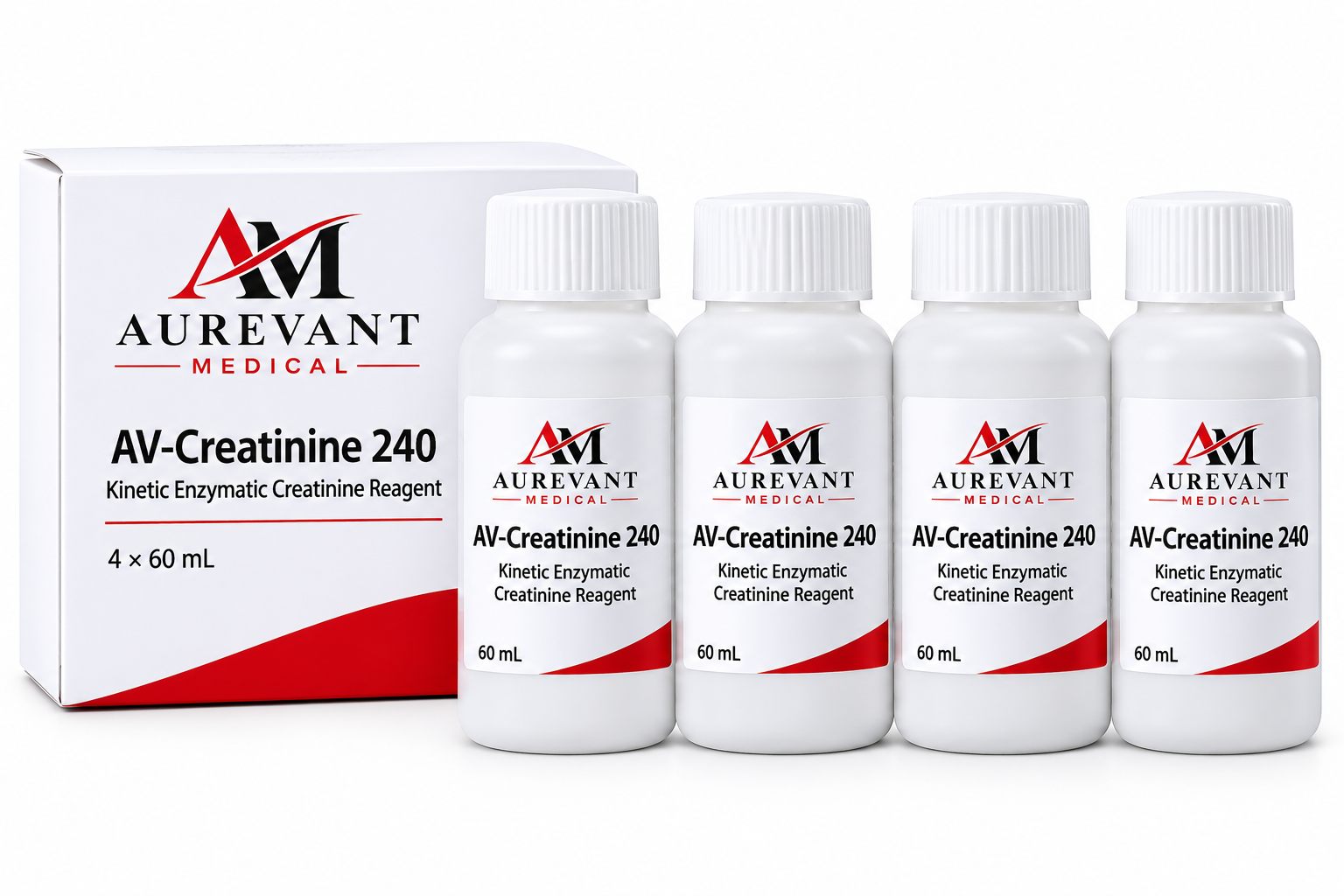
Liquid enzymatic creatinine reagent (creatininase / creatinase / sarcosine oxidase method) in 4 × 60 mL format. Improved rejection of common interferences and extended onboard stability. Designed by Aurevant Medical for accurate, specific creatinine measurement on automated and semi-automated clinical chemistry analyzers.
No approved datasheet is available for this product yet.
Product name and code identify the record only; they are not a substitute for current product documentation. Confirm intended use, configuration, availability, supported applications, and all technical and commercial terms in writing before procurement.
Support everyday laboratory testing requirements with clinical chemistry solutions designed for routine diagnostic workflows.
View applicationClinical chemistry applications supporting the laboratory assessment of kidney function.
View applicationApproved documentation
No approved documents are currently associated with this product.
Product questions
It uses a multi-enzyme enzymatic method (creatininase / creatinase / sarcosine oxidase) coupled to a peroxidase colorimetric detection system. This provides higher specificity than traditional Jaffe methods.
Yes. It is supplied as a liquid ready-to-use reagent. No reconstitution is required.
On a refrigerated analyzer (2–8 °C) the reagent typically remains stable for up to 28 days. Exact claims are stated in the package insert.
Yes. The enzymatic method shows significantly reduced interference from bilirubin, hemoglobin and certain non-creatinine chromogens compared with conventional alkaline picrate (Jaffe) methods.
Serum, plasma (heparin or EDTA) and urine (after appropriate dilution) are validated sample types.
Yes, on open-system analyzers after the laboratory has validated the application parameters. Aurevant Medical provides optimized applications for its own AV-Chem series.
Yes. When used with appropriate calibrators and laboratory-validated equations (e.g., CKD-EPI), the results support estimated glomerular filtration rate reporting.
Product enquiry
Request model-specific availability, configuration, delivery, warranty, training, and service information.